

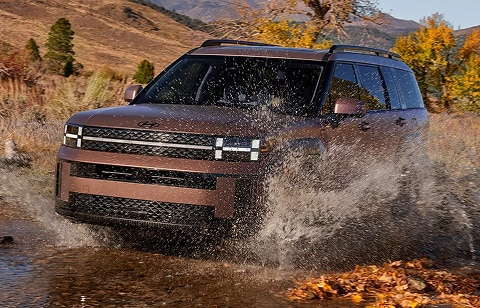
Hyundai's HTRAC all-wheel-drive system stands out as a smart approach to traction and stability. Unlike systems that simply send power to all four wheels constantly, HTRAC actively monitors what's happening beneath your vehicle and responds in real time. This technology brings meaningful improvements to everyday driving, whether you're navigating wet Texas roads during spring storms or taking a weekend trip through varied terrain.
The system operates quietly in the background, making continuous adjustments that most drivers won't consciously notice but will definitely feel. It's the kind of technology that shows its value when conditions challenge other vehicles, yet doesn't compromise efficiency during normal commuting.
What is Hyundai HTRAC? Understanding This All-Wheel Drive System
HTRAC is Hyundai's proprietary all-wheel-drive system built around intelligent torque distribution. The system dynamically shifts power between wheels based on what sensors detect about road conditions and vehicle behavior. Most of the time, your Hyundai operates in front-wheel drive to maximize fuel economy. When the system senses wheel slip or changes in vehicle dynamics, it redirects power to the rear axle within milliseconds.
What sets HTRAC AWD apart from traditional systems is its predictive capability. Rather than waiting for wheels to slip before engaging, HTRAC anticipates traction loss by monitoring 50 vehicle inputs over 100 times per second. These inputs include steering angle, throttle position, wheel speed, and dozens of other data points. This proactive approach means the system engages before you feel any loss of control. The result? Seamless power delivery that adapts to conditions without driver input.
How HTRAC Works in Everyday Driving
The beauty of HTRAC lies in how it handles real-world driving scenarios. During your morning commute through Plano, the system typically runs in front-wheel drive, delivering the efficiency you expect from a modern vehicle. When you accelerate onto the highway or encounter a slick patch from overnight rain, HTRAC responds instantly.
Sensor Technology and Intelligent Power Distribution
Multiple sensors throughout the vehicle feed data to HTRAC's electronic control unit at incredibly fast intervals. These sensors track wheel speed, lateral acceleration, yaw rate, steering input, and brake application. The system processes this information to determine exactly how much torque each axle needs for optimal traction. This constant analysis happens faster than any driver could manually respond, creating a safety net that's always active.
The intelligent power distribution doesn't just react to problems. HTRAC anticipates them by recognizing patterns in how you're driving and what the road surface is doing. If you're navigating a highway on-ramp at speed, the system can shift torque rearward to improve stability through the curve. During hard acceleration from a stoplight? It distributes power to prevent front-wheel spin that would waste momentum.
Front-to-Rear and Side-to-Side Torque Adjustment
HTRAC's capability extends beyond simple front-to-rear power distribution. The system works with your vehicle's stability control to create what engineers call brake-based torque vectoring. When you enter a corner, HTRAC applies selective braking to the inside wheels, which helps transfer more power to the outside wheels and rotate the vehicle through the turn more precisely. This front-to-rear adjustment combined with brake-assisted side-to-side control creates handling characteristics that feel planted and confident.
The torque adjustment happens so smoothly that most drivers experience it as a general sense of control rather than noticing specific interventions. Your Hyundai simply feels more connected to the road, with less tendency to understeer or feel vague through corners. This proves particularly noticeable in crossovers and SUVs, where higher centers of gravity can sometimes create less confident handling dynamics.
Key Benefits Drivers Notice with HTRAC AWD
Owners consistently report specific improvements once they experience Hyundai all-wheel drive vehicles equipped with HTRAC. These benefits show up in daily driving, not just extreme conditions.
Smoother Cornering and Better Acceleration Grip
The most immediate benefit appears in how your vehicle handles turns. HTRAC-equipped models maintain better composure through highway curves and roundabouts. The system's ability to distribute torque means the front wheels focus more on steering while rear wheels contribute to forward motion. This division of labor creates smoother, more predictable cornering behavior.
Acceleration grip improves noticeably, especially from standing starts or when merging into traffic. Front-wheel-drive vehicles sometimes struggle with torque steer or wheel spin during hard acceleration. HTRAC eliminates these issues by sending power rearward when front traction reaches its limit. You get cleaner, straighter acceleration with less steering correction needed.
Added Confidence in Unpredictable Weather
North Texas weather can shift quickly, and HTRAC adapts just as fast. When rain slicks the highways around Collin County or an unexpected ice storm hits, the system's proactive power distribution helps maintain control. You'll feel the difference immediately when other vehicles are struggling for traction. The system doesn't make your vehicle invincible, but it significantly expands the margin of safety in challenging conditions.
This confidence extends to loose surfaces as well. Gravel roads, muddy construction zones, or uneven terrain become less stressful when HTRAC is managing traction. The system prevents the lurching or slipping that can happen when one axle loses grip while the other maintains it.
HTRAC Drive Modes: Adapting to Different Road Conditions
Hyundai's approach to drive modes gives you control over how HTRAC behaves. Models equipped with the system typically offer multiple modes that adjust the torque split characteristics and throttle response to match specific scenarios.
|
Mode |
Torque Distribution |
Primary Benefit |
|
Smart |
Majority of power to front wheels |
Fuel efficiency in normal conditions |
|
Sport |
Up to 50% to rear wheels |
Agility and dynamic handling |
|
ECO |
Optimizes to all wheels, reduces during acceleration |
Fuel savings |
|
Comfort |
Approximately 70% front, 30% rear |
Stability |
|
Snow |
Pre-distributes to all four wheels |
Traction on slippery surfaces |
|
Mud/Sand |
Terrain-specific adjustments |
Off-road grip |
Smart mode prioritizes efficiency and comfort, keeping the vehicle in FWD most of the time and engaging the rear only when needed. Sport mode shifts up to 50% of power to the rear wheels, creating a more aggressive, responsive feel that's ideal for spirited driving. Comfort mode maintains approximately 70% front and 30% rear distribution for balanced stability.
Snow mode fundamentally changes how power gets delivered. It starts in a higher gear to prevent wheel spin, limits throttle response to avoid sudden power surges, and pre-distributes torque to all four wheels from the start. This mode proves valuable on ice or packed snow, though it's equally useful in heavy rain where traction is compromised. Mud and Sand modes make terrain-specific adjustments for off-road grip, particularly useful in the 2026 Santa Fe XRT with its standard HTRAC, all-terrain tires, and 8.3 inches of ground clearance.
2026 Hyundai Models Equipped with HTRAC
The 2026 Hyundai AWD models lineup offers HTRAC across a wide range of vehicles. The Tucson remains one of the most popular choices, combining compact dimensions with serious all-weather capability. Its intelligent power distribution makes it particularly well-suited for families who need versatility without the size of a larger SUV.
The Santa Fe brings HTRAC to the midsize segment, offering three rows and more cargo space while maintaining the traction benefits of Hyundai all-wheel drive. The Santa Fe XRT trim takes capability further with HTRAC as standard equipment, all-terrain tires, and 8.3 inches of ground clearance (1.3 inches more than standard models).
The Palisade represents the largest option in the Hyundai AWD SUV category, bringing HTRAC's capabilities to an eight-passenger platform. Even the stylish Santa Cruz pickup offers HTRAC as an option, expanding the system's reach beyond traditional SUVs. This variety means shoppers can explore Hyundai AWD vehicles that match their size requirements without sacrificing the technology's benefits.
HTRAC vs. Traditional AWD: What Makes It Different
Traditional all-wheel-drive systems often rely on simpler mechanical approaches. Some depend on viscous couplings that engage based on speed differences between axles. Others permanently drive all four wheels, which improves traction but hurts fuel economy. The comparison reveals several key advantages of Hyundai's system.
|
Feature |
HTRAC AWD |
Traditional AWD |
|
Operation |
Always monitoring, predictive pre-distribution |
Reactive, engages after slip |
|
Torque Control |
Front/rear/side-to-side, multi-mode adjustable |
Primarily front/rear, fewer modes |
|
Inputs Monitored |
50 vehicle inputs over 100 times per second |
Fewer sensors, less frequent |
|
Weight/Efficiency |
Lightweight (165 lbs), FWD-like MPG |
Heavier, lower efficiency |
|
Response |
Electronic variable-torque-split clutch with active torque control |
Mechanical, slower |
HTRAC's electronic control allows for infinitely variable torque distribution rather than fixed splits. The system can send anywhere from zero to 50 percent of power to the rear wheels based on conditions, rather than being locked into predetermined ratios. This variability means better efficiency during normal driving and more capability when conditions demand it.
The speed of response sets HTRAC apart as well. Older mechanical systems might take half a second or more to fully engage. HTRAC responds in milliseconds, catching traction loss before it becomes noticeable. This quick reaction time, combined with integration into the vehicle's stability control system, creates a more cohesive safety package than older designs can deliver.
At just 165 pounds, HTRAC's lightweight design minimizes weight penalties while maximizing functionality, contributing to better fuel economy compared to heavier always-on systems.
Experience HTRAC at Huffines Hyundai Plano
The best way to understand what HTRAC brings to your driving is experiencing it firsthand. We maintain an inventory of HTRAC-equipped models that includes all current vehicles with the system. Our team has earned recognition as a Hyundai Board of Excellence Award recipient, reflecting our commitment to expertise and service.
Schedule a test drive to experience how HTRAC performs in real conditions around Plano and the Dallas area. We can demonstrate the different drive modes and explain how the system handles various situations you'll encounter on North Texas roads. Whether you're considering a Tucson for its blend of efficiency and capability or a Palisade for its family-friendly space, experiencing HTRAC through actual driving is what makes the decision clearer.
Visit our showroom at 909 Coit Rd. in Plano, Monday through Saturday from 8:30 AM to 8 PM, or call 972-867-5000 to schedule your test drive. HTRAC gives you confidence in any condition, and we're here to match you with the right vehicle for your needs.
Image via Hyundai


