

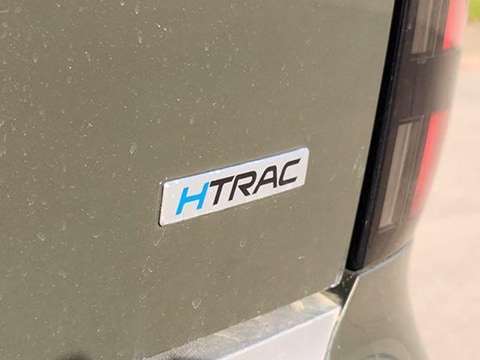
North Texas weather doesn't ask permission before it changes. A dry Tuesday morning on I-75 can turn into a flash flood by lunch, and Collin County drivers know how fast a clear commute can slick over. That's why the Hyundai HTRAC vs Subaru Symmetrical AWD question comes up so often at our showroom on Coit Road. Both systems are well engineered, but they solve traction differently, and the right one depends on how and where you actually drive. If you want to feel the difference yourself, browse our current inventory of HTRAC-equipped Hyundai SUVs before you finish reading.
Here's how each system works, where they diverge on North Texas roads, and which scenarios tend to favor one over the other.
How Hyundai HTRAC Technology Works
Hyundai engineers designed HTRAC as an electronic, on-demand AWD system rather than a mechanical, always-engaged one. Under normal conditions, power runs mainly to the front wheels for efficiency. The system shifts torque rearward only when sensors detect a reason to, whether that's wheel slip, hard acceleration, or a sudden change in steering input, and the shift happens without the driver doing anything.
Electronic Multi-Plate Clutch and Adaptive Torque Control
At the mechanical level, HTRAC uses a multi-plate clutch that the vehicle's ECU controls by adjusting clutch pressure. That pressure determines how much torque moves to the rear axle, and Hyundai's system can send anywhere from 0 to 50% of power rearward depending on conditions and the selected drive mode. This active front/rear torque control is what separates HTRAC from a fixed-split AWD layout, and clutch-pressure adjustment is the physical basis for that torque transfer.
The system is also fast. HTRAC monitors roughly 50 vehicle inputs, steering angle, throttle position, wheel speed, checking them more than 100 times per second. Response time is measured in milliseconds, compared to older mechanical AWD systems that may take half a second or longer to react. On acceleration or through a corner, HTRAC can also apply subtle inside-wheel braking to help rotate the vehicle more predictably on wet or snowy pavement. For the deeper mechanical breakdown, see our HTRAC AWD system explained post.
Drive modes shape how the system behaves. Smart mode keeps the vehicle mostly front-wheel drive and only engages the rear axle when it's needed, while Sport mode opens things up, allowing up to 50% of power to the rear for a more balanced, athletic feel. Comfort mode settles into roughly a 70/30 front-to-rear split for smooth daily driving. Snow mode starts the vehicle in a higher gear, limits throttle response, and pre-distributes torque to all four wheels before you need it, which matters on the rare icy morning Plano gets. There's also an AWD Lock button on most models that forces a continuous 50:50 split at speeds under roughly 25 mph, disengaging on its own as you speed up. That's the one setting where HTRAC behaves the way Subaru's system does by default, and it's useful on a wet boat ramp or loose gravel.
Prioritizing Efficiency During Everyday Coit Road and I-75 Commutes
Most North Texas driving is dry pavement and steady speeds, and Hyundai built HTRAC with that in mind. The system runs front-biased during dry highway cruising to cut drag and keep fuel economy close to what you'd get from a front-wheel-drive car. That matters on a daily grind down I-75 or across the Dallas North Tollway, where you're rarely asking for maximum traction but you're paying for every gallon regardless. HTRAC blends 4WD-style capability with FWD-like efficiency, saving the extra grip for moments that actually call for it, like a sudden downpour on Coit Road during rush hour.
How Subaru Symmetrical AWD Technology Works
Subaru takes a different philosophy. Rather than engaging AWD on demand, Symmetrical AWD stays active at all times, sending power to all four wheels continuously regardless of road conditions.
Full-Time Mechanical Power Delivery
Subaru's own materials describe Symmetrical AWD as full-time and always-on, with variable power delivery based on sensor detection rather than a simple on/off engagement. Traction is always present rather than activated in response to a slip event. Subaru also acknowledges that gas-powered AWD vehicles are less fuel-efficient than FWD or RWD vehicles, though more efficient than 4WD, and that the fuel impact is minimal during everyday dry, even-terrain driving. Many drivers accept that trade-off for the peace of mind of constant all-wheel engagement.
Boxer Engine Layout and Constant Traction
Symmetrical AWD is paired with Subaru's horizontally-opposed BOXER engine, a layout Subaru designed to keep the vehicle's center of gravity low while balancing engine movement and cutting vibration. Subaru states this pairing improves stability and handling, and that the low engine mounting position can also drop below the cabin in a frontal collision, which Subaru says helps protect passengers. It's a distinctive piece of engineering, and it's part of why Subaru's cornering feel is often described as flat and predictable.
One clarification worth making: "Symmetrical" describes the drivetrain layout rather than the torque split. Subaru mounts the boxer engine longitudinally with equal-length half-axles on both sides, which is genuinely unusual and is what keeps the center of gravity low. It's a description of geometry, not a claim about how power gets distributed.
HTRAC vs. Symmetrical AWD at a Glance
With both systems on the table, here's where they actually diverge:
| Feature | Hyundai HTRAC | Subaru Symmetrical AWD |
|---|---|---|
| Drivetrain type | Electronic, on-demand AWD with multi-plate clutch | Full-time, always-on mechanical AWD |
| Torque distribution | Variable, 0–50% to rear based on sensor input; adjusts by drive mode | Continuous power to all four wheels |
| Fuel Economy (compact SUV example) | Tucson AWD: 26 combined MPG (24 city/30 hwy) | Forester AWD: up to 33 MPG |
| Response mechanism | Sensor-driven engagement, ECU-controlled clutch pressure | Constant delivery, no engagement lag by design |
| Notable tech | Drive modes (Smart, Sport, Comfort, Snow); inside-wheel braking in corners | Boxer engine low center of gravity pairing |
Performance Comparison on North Texas Roads
What actually matters is how each system behaves on the roads Collin County drivers use every day, not just the numbers on a spec sheet.
Handling Sudden Rainstorms and Slick Highways
North Texas storms have a habit of showing up fast, dumping rain that slicks highways within minutes. This is exactly the kind of weather where proactive power distribution helps maintain control on Collin County roads. Because HTRAC's sensors check wheel speed and steering input over a hundred times per second, the system can shift torque rearward before a driver even fully registers reduced grip.
Subaru's full-time approach reaches the same goal differently. All four wheels receive power continuously, so there's no engagement step at all. Worth knowing, though: most Subaru automatic transmissions default to roughly 60% front and 40% rear through a computer-controlled multi-plate clutch, shifting toward an even split when the system detects a speed difference between axles. So both systems use a clutch pack to vary torque. The difference is the starting point, with Subaru always sending some power rearward and Hyundai holding it near the front until sensors call for it.
Cornering Stability and Acceleration Response
Subaru's engineering gives it a genuine edge in one respect: the low-mounted BOXER engine and full-time AWD work together to limit chassis roll and pitch during cornering and braking, according to Subaru's own content. Drivers who want a flat, connected feel through curves will notice that.
HTRAC counters with its inside-wheel braking during turns, which subtly manages rotation on wet or snowy roads, plus the ability to route up to 50% of torque rearward the moment sensors detect reduced adhesion during acceleration or cornering. The two approaches get to similar outcomes through different means: mechanical constancy on one side, sensor-driven adaptation on the other.
Fuel Efficiency in Hot-Weather Commuting
This is where drive-mode flexibility starts to matter for daily ownership costs. The 2026 Hyundai Tucson comes in a FWD trim rated 25 city/33 highway/28 combined MPG, while the HTRAC AWD trim is rated 24 city/30 highway/26 combined MPG. Independent testing of the AWD Tucson returned similar real-world numbers to its EPA-estimated 26 combined MPG (24 city/30 highway). The 2026 Subaru Forester AWD, meanwhile, is rated up to 33 MPG with Symmetrical AWD standard. These are different vehicle classes tested under different conditions, so it's not a straight comparison, but side by side they show two very different efficiency philosophies: Hyundai's front-biased, on-demand system versus Subaru's full-time delivery.
Which AWD System Is Better for North Texas Drivers?
Both systems earn their place, just in different ways. If you're a daily commuter running Coit Road, I-75, or the Dallas North Tollway in mostly dry conditions with the occasional storm, HTRAC's front-biased efficiency and rapid sensor response are built almost exactly for that pattern. You get better everyday fuel economy and a system that steps in fast when weather turns.
If you're a family or weekend driver who wants constant, uniform traction regardless of conditions and values Subaru's low-center-of-gravity cornering feel, Symmetrical AWD's always-on approach delivers that consistency by design. Neither choice is wrong. Given how rare true ice events are in Collin County, the Hyundai or Subaru decision often comes down less to worst-case weather and more to daily driving habits, efficiency priorities, and which cabin and features fit your life.
Why Huffines Hyundai Plano Is Your Home for HTRAC-Equipped SUVs
A No-Pressure Way to Compare Trims
We're located at 909 Coit Road in Plano, about 25 minutes from Dallas, and we carry a full lineup of HTRAC-equipped Hyundai models, including the Tucson, Santa Fe, Palisade, and Santa Cruz. We built our sales process around a no-pressure shopping experience, so you can look over trims and drive modes at your own pace, and even walk through Hyundai's Certified Pre-Owned inspection standards without feeling rushed into anything.
Ongoing Support From Our Service Center
Ownership costs matter too, and that's where our modern service center comes in. Whether it's routine maintenance, warranty work, or a question about how your HTRAC system is behaving in changing weather, our factory-trained technicians handle it. You can schedule service or ask questions anytime through our Hyundai service center.
Test Drive an HTRAC-Equipped Hyundai Today
Reading specs only gets you so far. The real test is feeling how HTRAC responds the next time a Collin County storm rolls in or you merge onto I-75 during rush hour. Stop by 909 Coit Road in Plano, Monday through Saturday from 8:30 AM to 8 PM, or reach out to schedule your test drive and we'll get you behind the wheel of a Hyundai built for North Texas roads.


